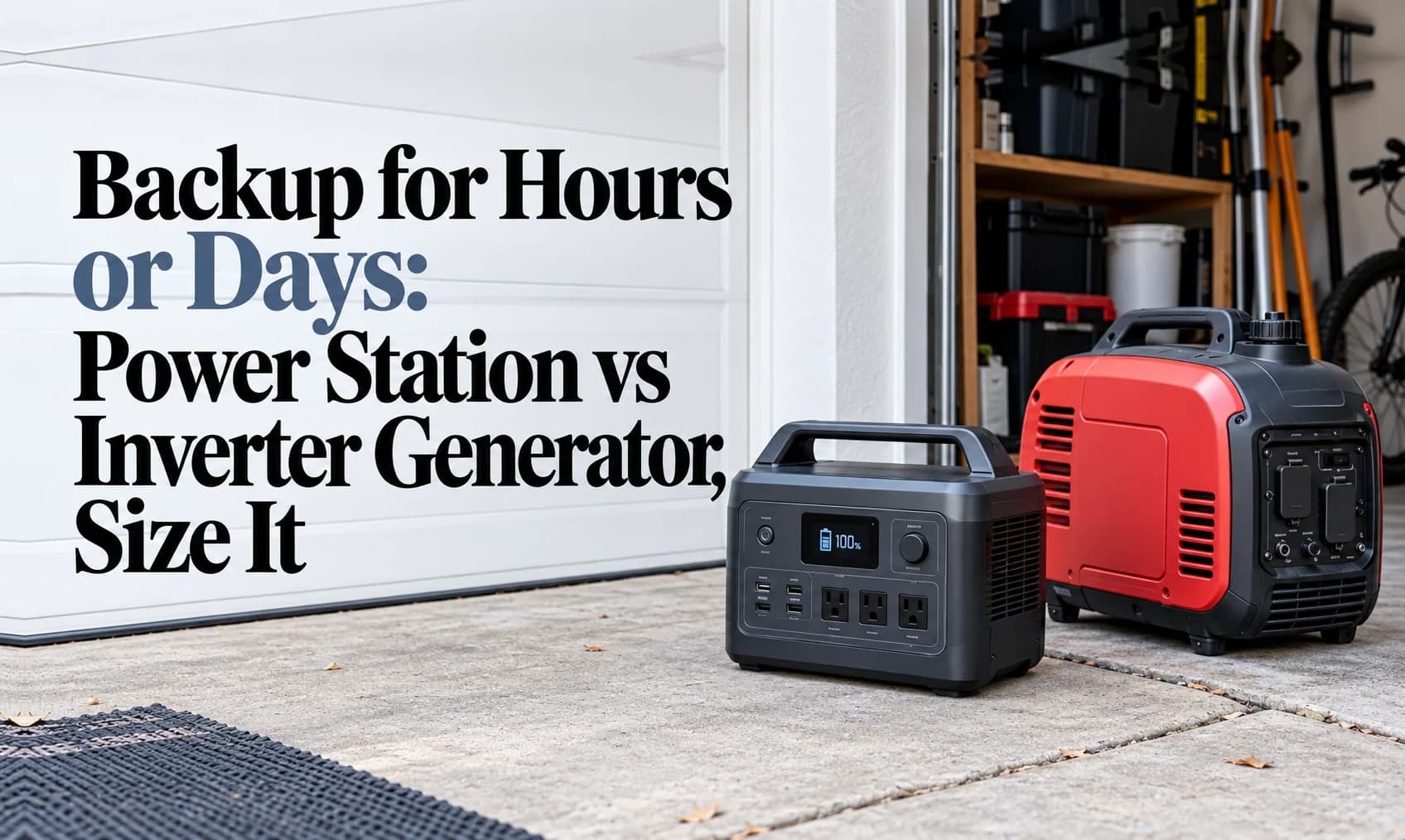
Power Station vs Inverter Generator: Backup for Hours or Days
For short-to-medium outages, indoor use, and anything noise-sensitive, choose a portable power station; for long, high-power, outdoor runs, choose an inverter generator. The generator wins on raw runtime and total output as long as you can keep feeding it fuel; the power station wins on silence, indoor safety, and zero refueling. For home backup, the classic default used to be a gas generator, and power stations are now a genuine alternative with real tradeoffs depending on your situation. If you're also weighing a fixed whole-home battery system against either option, see our portable power station vs. whole-home battery comparison.
How Each One Works
An inverter generator burns fuel (gasoline, propane, or in some models natural gas) in a small engine that spins an alternator, then passes that raw output through an inverter that cleans it into stable AC power. That conditioning is why inverter models are the usual choice for laptops, CPAP machines, and other sensitive electronics, and why they run quieter and more efficiently than older open-frame generators. A portable power station works on a different principle: it stores electricity in a battery (almost always LiFePO4) and releases it through a built-in inverter. There is no combustion, no exhaust, and no engine. Once the battery is empty it's done until you recharge it from a wall outlet, a car, or solar panels. A "solar generator" is not a separate category — it's a power station sold with solar panels, or one that accepts solar input.
Head-to-Head Comparison
| Factor | Portable Power Station | Generator (Inverter / Gas) |
|---|---|---|
| Runtime | Limited by battery capacity; recharge via AC/solar/car | Unlimited, as long as fuel supply lasts |
| Indoor use | Safe — zero emissions | Never safe indoors — carbon monoxide risk |
| Noise | Silent to moderate fan noise under load (full breakdown) | Loud (60-90 dB typical; inverter models toward the quieter end) |
| Output ceiling | Most units top out around 2-4kW | Portable models reach 7kW and beyond |
| Setup complexity | Plug and play | Requires fuel storage, occasional maintenance |
| Upfront cost | $400-2,000+ depending on capacity | $400-1,500+ depending on output (inverter models cost more than open-frame) |
| Ongoing cost | Minimal (electricity to recharge) | Fuel costs, which spike during emergencies |
| Best for | Short-to-medium outages, medical equipment, indoor use | Extended multi-day outages with reliable fuel access |
Where Power Stations Win
Zero emissions and indoor safety is the single biggest advantage — a power station can sit in your living room or bedroom running a CPAP machine (see our CPAP power outage guide) with zero carbon monoxide risk. They're also silent, require no fuel storage, and need essentially no maintenance.
Where Generators Win
Unlimited runtime as long as fuel is available is the core generator advantage — for extended multi-day outages where recharging a power station isn't practical, a generator with a stocked fuel supply keeps running indefinitely. Generators also typically offer higher continuous output at a lower upfront cost per watt for whole-home coverage. The catch is that a portable generator's tank lasts from a few hours at full load to roughly a day at light load depending on the model, so a multi-day outage means storing and rotating fuel and refueling on a schedule.
Inverter vs. Conventional Generators
If you're leaning generator, the inverter type is usually worth the premium for a home or camping setup. Per Consumer Reports' breakdown of the tradeoffs, inverter generators cost significantly more per watt than conventional open-frame units, but they deliver cleaner power (important for sensitive electronics and medical devices), run quiet enough not to drown out a conversation, and burn less fuel because the engine only ramps up as high as the load requires. Conventional generators stay attractive for job sites and whole-circuit backup where raw output per dollar matters more than power quality or noise.
Surge Power: Why Wattage Alone Misleads
Appliances with a motor or compressor (refrigerators, well pumps, sump pumps, power tools) draw two to three times their running wattage for a moment at startup. A generator or power station with a low surge rating will shut down or fail to start that device even if its continuous rating looks sufficient on paper. Large generators generally have more surge headroom than small power stations, which is one reason sump pumps and well pumps often push buyers toward bigger units — see our running watts vs. surge watts guide, and our guides for the sump pump and space heater cases specifically. Use the runtime calculator and our wattage sizing guide to turn your own device list into a capacity target before you shop.
Which One for Which Situation
| Situation | Better fit | Why |
|---|---|---|
| Camping, car camping | Power station | Lights, phones, and a cooler without fumes or noise disturbing the campsite |
| Short outage (hours to a day) | Power station | Keeps the fridge, router, and medical devices running with no noise or CO risk — see the fridge runtime guide |
| CPAP or oxygen equipment indoors | Power station | The only safe indoor option — see our medical equipment power guide |
| Multi-day outage | Generator (with stored fuel) | No portable power station holds enough energy for days of continuous appliance use |
| RV with AC and fridge running constantly | Generator, or a large solar-charged battery setup | Continuous heavy draw beats a finite battery — see the RV living guide |
| Construction site, power tools all day | Generator | Continuous output and easy refueling — see the construction site guide |
Safety: Carbon Monoxide and Battery Risk
Carbon monoxide is the biggest risk with any fuel-burning generator, and it causes preventable deaths after major storms every year. A generator run in a garage, basement, or near an open window can fill a living space with lethal gas within minutes, so these rules are not optional:
- Never run a generator indoors, in a garage, or in a carport, even with the door open. The CPSC specifically warns that porches and carports are too close to the home.
- Keep it at least 20 feet from the house with the exhaust pointed away from windows and doors — that is the CPSC's stated minimum. NIST and CDC modeling found that at 30 feet with the exhaust pointing away from the house, indoor carbon monoxide fell to about 3% of the level seen with the exhaust pointing toward it, so more distance is better when you can manage it.
- Prefer a model with automatic carbon monoxide shutoff that meets PGMA G300-2018 and UL 2201. The CPSC estimates those two standards reduce CO poisoning deaths by 87% and 100%, respectively.
- Run battery-powered carbon monoxide alarms in the home regardless of which option you choose.
Power stations carry a different, much smaller risk. Lithium batteries can in rare cases overheat (thermal runaway) after physical damage, poor charging practices, or manufacturing defects, which is why reputable units include a battery management system and why buying certified products matters. LiFePO4 chemistry is considerably more stable — see our LiFePO4 battery guide, safety guide, and indoor use guide for the details. Avoid charging a power station in direct sun or extreme heat.
The Real-World Answer: Many Households Use Both
Increasingly, the smartest approach isn't choosing one exclusively — a power station covers quiet, indoor-safe, immediate backup for medical equipment and essentials, while a generator (used safely outdoors, following all ventilation guidance) handles extended high-draw needs like a well pump or central systems. During a hurricane or extended grid failure, this combination avoids the single point of failure that either option has alone. If you can only afford one first, a power station is the safer starting point for most households; add a generator later if your area sees multi-day outages. See our home backup picks for specific models.
Cost Over Time
A power station's ongoing cost is minimal (just electricity to recharge, or free if using solar), while a generator's fuel costs compound over an extended outage — and fuel often becomes scarce or price-gouged immediately after a major storm, precisely when you need it most. See our full cost breakdown for the exact per-kWh math.
Maintenance Requirements Compared
A generator needs real, recurring upkeep: periodic oil changes, carburetor cleaning if it sits unused for long stretches (a very common failure mode when a generator hasn't run in months and is suddenly needed), fuel stabilizer for stored gasoline, spark plug replacement, and an occasional test-run under load to confirm it'll actually start when needed. A power station needs essentially none of this — no fluids, no combustion components, no periodic servicing. The most it asks is a top-off charge every few months and storage away from extreme temperatures. For anyone who has ever discovered a stored generator won't start during the exact emergency it was bought for, this difference is not a minor convenience.
Total Cost of Ownership: A 5-Year Example
| Cost Factor | Power Station | Gas Generator |
|---|---|---|
| Upfront (mid-capacity unit) | ~$1,200 | ~$800 |
| Annual maintenance | $0 | ~$100-150 (oil, filters, tune-up) |
| Fuel over 5 years (occasional outage use) | ~$0-50 (grid electricity) | ~$200-400 (gasoline, plus emergency price spikes) |
| Replacement battery/major part | Rare within 5 years (LiFePO4) | Possible (carburetor, starter) |
| Approx. 5-year total | ~$1,250 | ~$1,700-2,150 |
Small inverter generators typically start around $400-600 for 1,000-2,000W units and run past $1,500 for 3,000W-plus models, so the example above sits in the middle of that range. The generator's lower upfront cost narrows or reverses once maintenance and fuel are factored in over several years of ownership — though a generator's unlimited runtime still has real value for households facing genuinely extended, multi-day-or-longer outages where a power station's finite capacity becomes the limiting factor regardless of cost.
Frequently Asked Questions
Can a power station replace a generator entirely?
For most households running essentials (fridge, medical equipment, lighting, device charging), yes — a properly sized power station covers this without a generator. For whole-home coverage including central AC, electric ranges, or well pumps over an extended period, a generator or larger fixed battery system is usually still necessary.
Is it safe to run a gas generator during a hurricane?
Only outdoors, at least 20 feet from any structure (30 feet is better when possible), with the exhaust pointed away from windows and doors — never indoors or in a garage, even with the door open, due to carbon monoxide risk. See our full hurricane preparedness checklist for complete safety guidance.
What is the downside of an inverter generator?
Inverter generators need a constant fuel supply, produce carbon monoxide, and require upkeep like oil changes and spark plug replacement that power stations don't. They're also louder than a power station and can never be used indoors.
Can I power my house with an inverter generator?
A mid-size inverter generator can run select circuits, like a fridge, some lights, and a few outlets, if connected through a properly installed transfer switch or heavy-duty extension cords, but it won't run a whole home's simultaneous load. Full-home coverage typically requires a larger standby generator rather than a portable inverter model.
Can a portable power station power a house?
A power station can keep critical devices running (phones, Wi-Fi, a fridge, medical equipment) for hours to a day depending on its watt-hour capacity, but it can't sustain whole-house loads like central air or an electric range. For broader coverage, compare your needs against a whole-home battery system rather than a single portable unit.
Related Articles
 Comparisons & Buying Guides
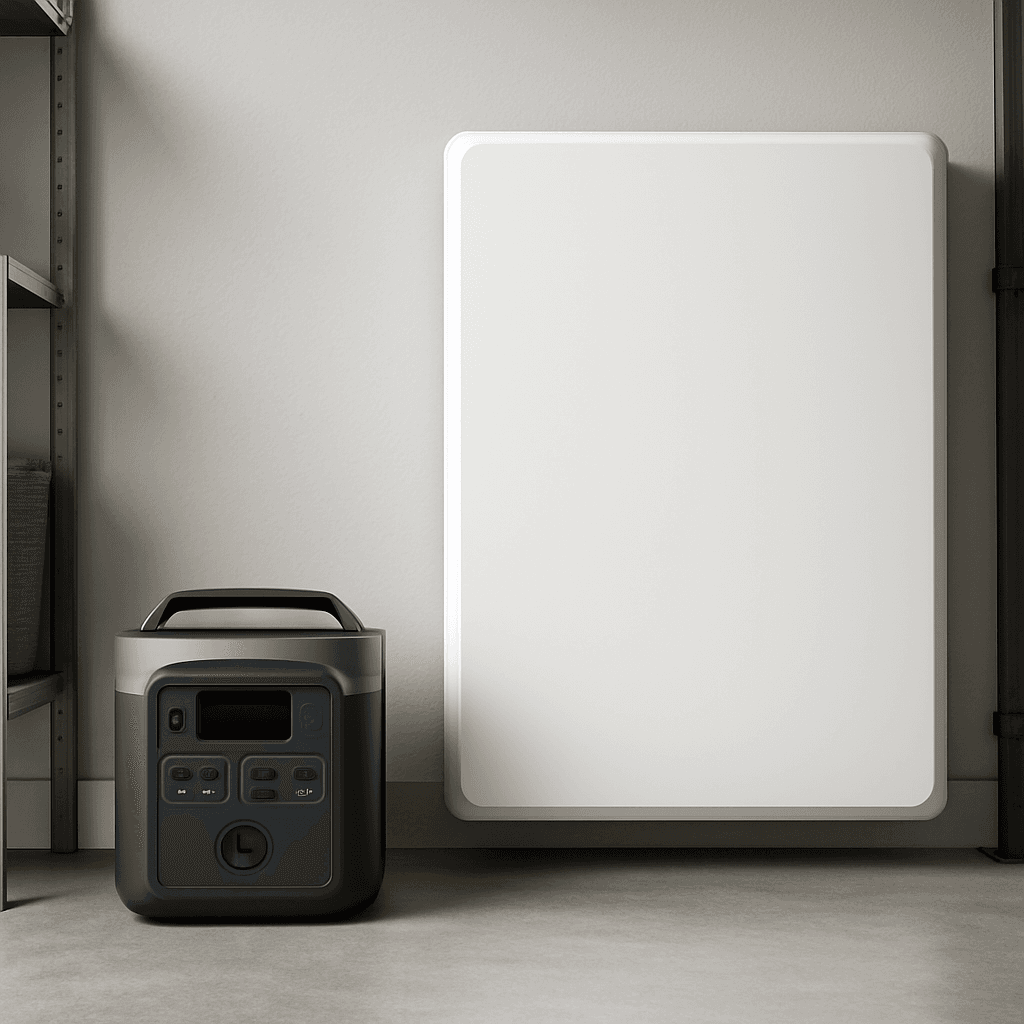
Portable Power Station vs. Whole-Home Battery System: Which Do You Actually Need?
A Tesla Powerwall costs $11,500-$16,000+ installed. A portable power station covers most of the same essentials for a fraction of that. Here's how to actually decide.
 Comparisons & Buying Guides
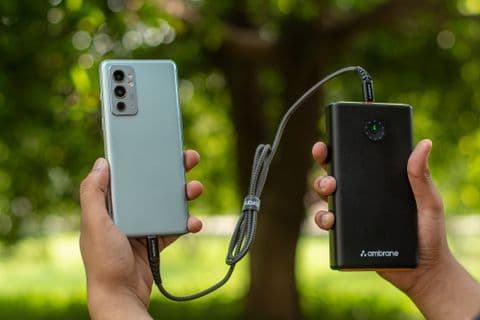
Power Bank vs. Power Station: What's the Real Difference?
They both store and dispense electricity, but a power bank and a power station aren't interchangeable. Here's what actually separates them and which one you need.
 Comparisons & Buying Guides
Can You Rent a Portable Power Station Instead of Buying One?
Renting is a real option if you only need backup power for a single trip or event. Here's where to actually rent one, real costs, and when renting beats buying.