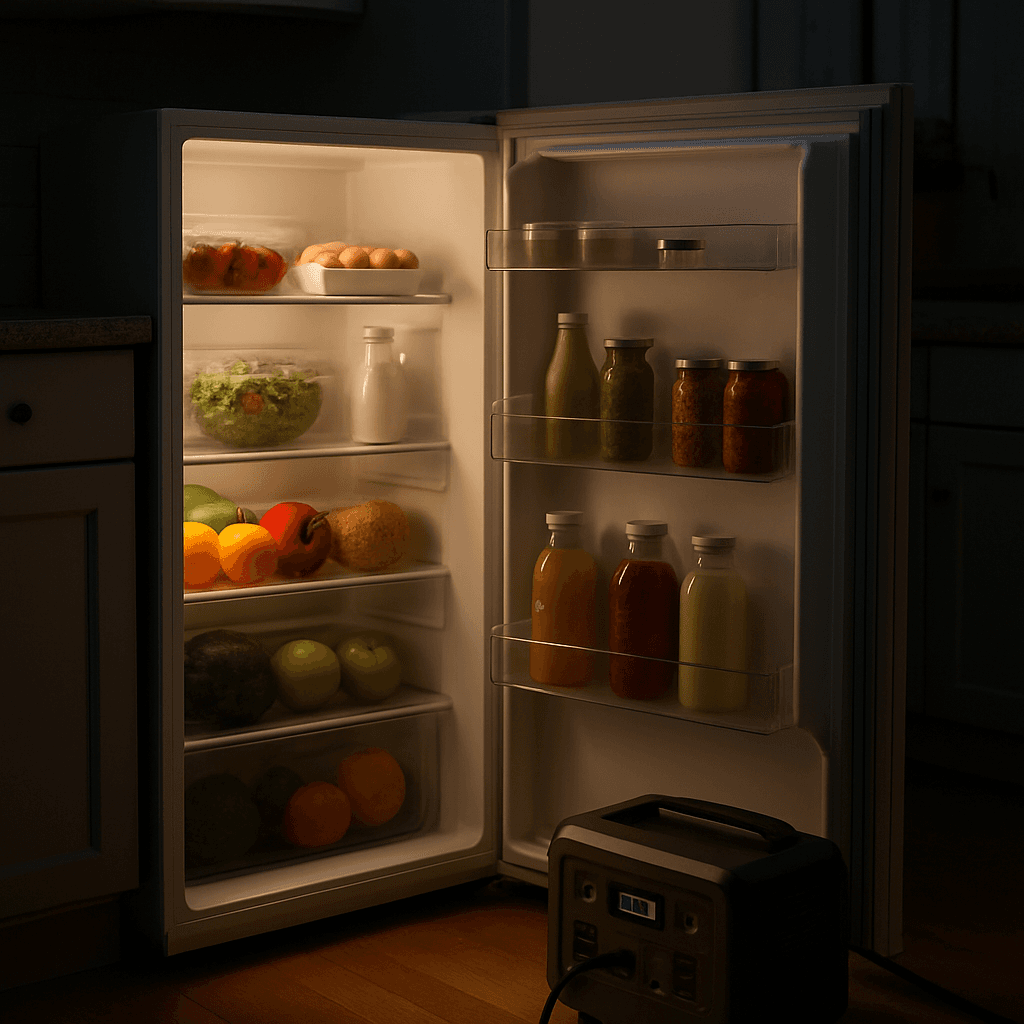
How Long Can a Power Station Run Your Fridge? Real Numbers by Size
The short answer: a 2,000Wh-class power station runs a typical full-size refrigerator for about a day (24 to 27 hours), an old or large fridge for 11 to 13 hours, and an efficient one for close to 40. A 1,000Wh unit gives about 13 hours for a typical fridge, and a 4,096Wh unit about 54. The range comes from the fridge: a refrigerator uses 100 to 250W only while its compressor runs, but it cycles, so its average draw over a day is much lower, usually about 40 to 85W. To get your own number, divide the EnergyGuide label's kWh per year by 8.76 (see below). Keeping food safe during an outage is one of the top reasons people buy a power station, so here is the math, with real measured battery capacity and the food-safety rules.
Three Different Fridge Numbers
| Number | What it is | Typical value |
|---|---|---|
| Running watts | Draw while the compressor is on | about 100-250W (large or older units up to 300-400W) |
| Average watts | Draw averaged over a day, including the off-cycles | about 40-85W for most modern full-size fridges |
| Startup surge | Brief spike when the compressor starts | usually quoted at 2-3x running watts, sometimes more |
Runtime depends on the average, because the compressor spends much of the day off. The surge only decides whether the station can start the compressor at all.
Find Your Fridge's Real Number in 30 Seconds
Check the yellow EnergyGuide label for the estimated yearly kWh (or look up your model in the ENERGY STAR product finder), then:
Average watts = kWh per year × 1,000 ÷ 8,760 (about kWh per year ÷ 8.76)
| Fridge | Yearly use | Average draw |
|---|---|---|
| ENERGY STAR 18.2 cu ft top-freezer | 366 kWh | about 42W |
| 18.1 cu ft top-freezer used as the federal reference | 404 kWh | about 46W |
| US average refrigerator-freezer (DOE, 2016 data) | 588 kWh | about 67W |
| Large ENERGY STAR 27.9 cu ft model | 726 kWh | about 83W |
Larger, older, or fuller-featured fridges (ice makers, through-the-door water) use more, and a hot kitchen or frequent door openings add to it.
Runtime by Power Station
Based on independently measured usable energy where available (the AC70 uses about 85% of rated). The columns show an efficient fridge (45W average), the typical US fridge (70W), and a conservative case for an old or large unit in a hot room (150W):
| Power station | Usable energy | Efficient (45W) | Typical (70W) | Old or large (150W) |
|---|---|---|---|---|
| Bluetti AC70 | about 650Wh | about 14 hours | about 9 hours | about 4 hours |
| Jackery Explorer 1000 v2 | 910Wh (OutdoorGearLab) | about 20 hours | about 13 hours | about 6 hours |
| Jackery Explorer 2000 v2 | 1,710Wh (OutdoorGearLab) | about 38 hours | about 24 hours | about 11 hours |
| Bluetti Elite 200 V2 | 1.91kWh (StorageReview) | about 42 hours | about 27 hours | about 13 hours |
| EcoFlow DELTA Pro 3 | 3.79kWh (OutdoorGearLab) | about 84 hours | about 54 hours | about 25 hours |
The station itself uses a little power while its inverter is on, so real runtime is slightly lower than the table. Plan with the middle or right column if you want a margin.
Will It Start the Compressor?
The compressor draws a brief spike each time it starts. The usual rule is 2 to 3 times running watts, planning guides suggest assuming up to 5 times when the figure is unknown, and one published measurement of a full-size kitchen fridge recorded about 1,420W for roughly 0.3 seconds at start, against 145W running. A station with a high enough surge rating handles this without trouble: for example Jackery lists 3,000W surge for the Explorer 1000 v2, and Anker lists 4,000W peak for the SOLIX C2000 Gen 2. A very small station can fail to start the compressor even if its capacity looks fine on paper. See our running watts vs surge watts guide.
Mini Fridges
A mini fridge's rated wattage (often 60 to 100W) is its draw while cooling, and its average is typically a fraction of that once the compressor cycles. Most mini fridges are fine on any station rated 300W or more continuous; a 768Wh unit can run one for most of a day.
Food Safety: What the USDA Says
A refrigerator keeps food safe for about 4 hours if unopened, a full freezer for about 48 hours, and a half-full freezer for about 24, according to the USDA. Keep the doors closed, and use a fridge thermometer to verify the interior stays at or below 40°F (4°C). Perishable food that has been above 40°F for more than 4 hours should be discarded, and you should never taste food to judge its safety. This gives you real time before backup power matters, and a buffer if your station runs down.
Ways to Stretch the Runtime
- Open the doors as little as possible. Every opening lets warm air in and makes the compressor work harder.
- Keep it full. Thermal mass helps; fill empty space with water bottles or ice packs.
- Prioritize the freezer if you can't cover both: frozen food that stays frozen is safe much longer than fridge contents.
- Run it on a timer only if the thermometer says it's safe. Cycling the fridge on and off can stretch runtime, but keep the interior at or below 40°F and consolidate food.
- Add solar. Panels recharge the station during the day. See our solar panel sizing guide and solar recharge time guide.
- Add a generator for multi-day outages. The station still runs the fridge silently; the generator only tops up the battery. See power station vs gas generator.
Recommended Units
For a mini fridge or a short outage, a Bluetti AC70 covers most of a day. For a full-size fridge, a Jackery Explorer 1000 v2 gives about 13 hours at typical draw and the Jackery Explorer 2000 v2 about 24; the Bluetti Elite 200 V2 and EcoFlow Delta 2 Max add expansion for longer outages. See our expandable capacity guide, and our hurricane checklist for storm planning.
Disclosure: WattStation HQ may earn a commission if you purchase through links on this page, at no extra cost to you. This does not affect our rankings — see our editorial policy.
Frequently Asked Questions
How long will a 1,000Wh power station run a refrigerator?
About 13 hours for a typical fridge (70W average) using a measured 910Wh of usable energy, from 20 hours for an efficient fridge to 6 hours for an old or large one. A 2,000Wh-class station roughly doubles those numbers.
How do I find my refrigerator's wattage?
Divide the kWh per year on its EnergyGuide label by 8.76 to get average watts. A plug-in watt meter left on for 24 to 72 hours gives an even more exact figure. Running watts (while the compressor is on) are usually listed on the nameplate in amps and volts.
How much battery do I need to run a fridge for a week?
At a typical 70W average, a week is about 11.8kWh (70W × 24 × 7); at 150W it is about 25kWh. Neither is realistic on one portable station, so plan around a realistic outage length, keep the fridge closed, prioritize the freezer, and add solar or a generator to recharge.
Is it safe to run a fridge intermittently to save power?
Only if the interior stays at or below 40°F (4°C), checked with a fridge thermometer, and you limit door openings. If it climbs above 40°F for more than 4 hours, perishable food should be discarded.
Do I need a bigger power station just for a full-size fridge?
Not necessarily. A 1,000Wh unit covers about half a day at typical draw; a 2,000Wh unit covers a day or more. An expandable system or a mid-size unit plus solar can cover a longer outage without buying the largest unit up front.
Power Stations We'd Look At for This
Picked from our reviews for this scenario. Prices change often, so check the current price before you buy.
This page contains affiliate links. See our affiliate disclosure.
Jackery Explorer 1000 v2
4.4/5 in our review
Bluetti Elite 200 V2
4.5/5 in our review
EcoFlow Delta 2 Max
4.5/5 in our review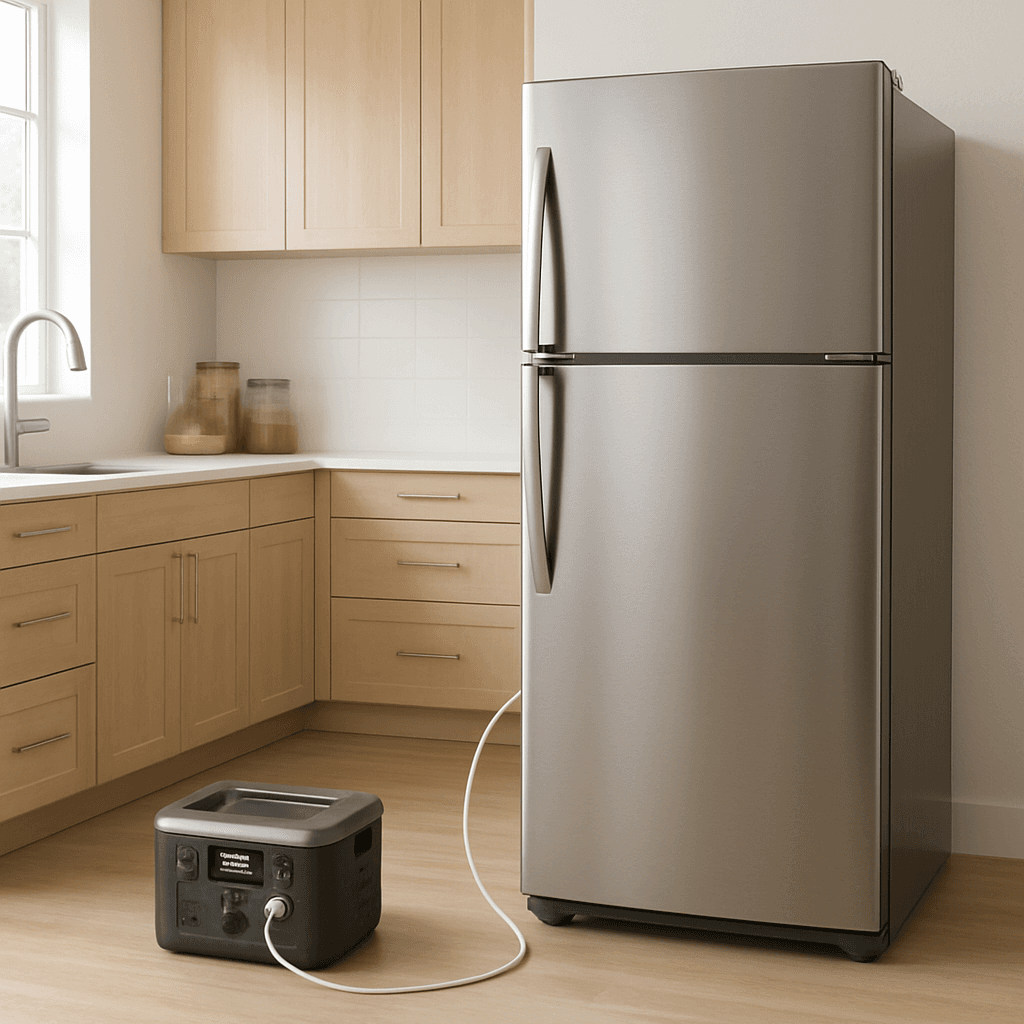
Jackery Explorer 2000 v2
4.5/5 in our reviewRelated Articles
 Emergency Preparedness
Can an EMP Destroy Your Power Station? What the Science Actually Says
Batteries are more EMP-resistant than most people assume, but the electronics inside a power station aren't. Here's the real science of EMP risk and Faraday cage protection.
 Emergency Preparedness
Winter Storm Power Outage Preparedness Guide (Texas Edition)
The 2021 Texas winter storm exposed how unprepared the grid can be for extreme cold. Here's how to plan backup power for Texas winter weather specifically.
 Emergency Preparedness
What to Do When the Power Goes Out: A Step-by-Step Guide
What to do in the first 15 minutes and hours of a power outage: check the scope, unplug electronics, food safety times, carbon monoxide rules, medical needs, and backup power priorities.